PEMS 6.6.4
:: DESCRIPTION
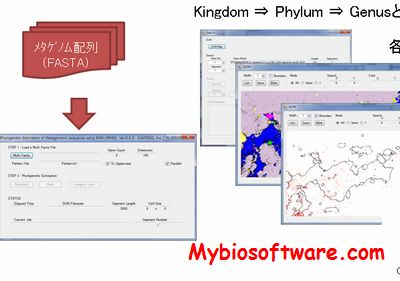
PEMS :Phylogenetic Estimation of Metagenomic sequence using BLSOM
::DEVELOPER
Bioinformatics Lab, Niigata University.
:: SCREENSHOTS
:: REQUIREMENTS
- Windows 7
- Microsoft .NET Framework 4.0
:: DOWNLOAD

:: MORE INFORMATION
:: DESCRIPTION
PEMS :Phylogenetic Estimation of Metagenomic sequence using BLSOM
::DEVELOPER
Bioinformatics Lab, Niigata University.
:: SCREENSHOTS
:: REQUIREMENTS
:: DOWNLOAD
:: MORE INFORMATION
:: DESCRIPTION
MetaCluster is an unsupervised binning method for metagenomic sequences.Existing binning methods based on sequence similarity and sequence composition markers rely heavily on the reference genomes of known microorganisms and phylogenetic markers. While MetaCluster is an integrated binning method based on the unsupervised top-down separation and bottom-up merging strategy, it can bin metagenomic sequencing datasets with mixed complex species abundance ratios from the exactly equal situation to the extremely unbalanced situation with consistently higher accuracy when compared with other recently reported methods.
MetaCluster-TA is a new software for binning and annotating short paired-end reads.
MetaAnnotator is a novel software for binning and annotating short paired-end reads.
::DEVELOPER
Bioinformatics Research Group of Hong Kong University
:: SCREENSHOTS
N/A
:: REQUIREMENTS
:: DOWNLOAD

:: MORE INFORMATION
Citation:
BMC Genomics. 2014;15 Suppl 1:S12. doi: 10.1186/1471-2164-15-S1-S12. Epub 2014 Jan 24.
MetaCluster-TA: taxonomic annotation for metagenomic data based on assembly-assisted binning.
Wang Y, Leung H, Yiu S, Chin F.
Wang, Yi, Henry C.M. Leung, S.M. Yiu, Francis Y.L. Chin. (2012)
MetaCluster 4.0: A Novel Binning Algorithm for NGS Reads and Huge Number of Species,
Journal of Computational Biology, 19, 241-249.
:: DESCRIPTION
MetaCompass is a software package for comparative assembly of metagenomic reads. MetaCompass achieves comparable assembly performance to the state of the art de novo assemblers, but these two different approaches complement each other a lot. So combining contigs between MetaCompass and other independent de novo assemblers give us the best overall metagenomic assembly.
::DEVELOPER
:: SCREENSHOTS
N/A
:: REQUIREMENTS
:: DOWNLOAD
:: MORE INFORMATION
:: DESCRIPTION
Centrifuge is a very rapid and memory-efficient system for the classification of DNA sequences from microbial samples, with better sensitivity than and comparable accuracy to other leading systems.
::DEVELOPER
The Center for Computational Biology at Johns Hopkins University
:: SCREENSHOTS
N/A
:: REQUIREMENTS
:: DOWNLOAD
:: MORE INFORMATION
:: DESCRIPTION
MaxBin is a software for binning assembled metagenomic sequences based on an Expectation-Maximization algorithm.
::DEVELOPER
:: SCREENSHOTS
N/A
:: REQUIREMENTS
:: DOWNLOAD
:: MORE INFORMATION
Citation
MaxBin 2.0: an automated binning algorithm to recover genomes from multiple metagenomic datasets.
Wu YW, Simmons BA, Singer SW.
Bioinformatics. 2015 Oct 29. pii: btv638.
:: DESCRIPTION
Woods tool using an integrated approach for fast and accurate functional annotation of proteins in both genomic and metagenomic datasets.
::DEVELOPER
:: SCREENSHOTS
N/A
:: REQUIREMENTS
:: DOWNLOAD
:: MORE INFORMATION
:: DESCRIPTION
CLIOR (CLassification Improvement with Overlapping Reads) is a metagenomic classification method that exploits the information captured by the reads overlap graph of the input dataset in order to improve recall and f-measure.
::DEVELOPER
:: SCREENSHOTS
N/A
:: REQUIREMENTS
:: DOWNLOAD
:: MORE INFORMATION
Citation
BMC Genomics, 18 (Suppl 10), 917 2017 Dec 6
Higher Recall in Metagenomic Sequence Classification Exploiting Overlapping Reads
Samuele Girotto , Matteo Comin , Cinzia Pizzi
:: DESCRIPTION
MetaPhyler is a novel taxonomic classifier for metagenomic shotgun reads, which uses phylogenetic marker genes as a taxonomic reference. Our classifier, based on BLAST, uses different thresholds (automatically learned from the reference database) for each combination of taxonomic rank, reference gene, and sequence length. Our reference database includes marker genes from all complete genomes, several draft genomes and the NCBI nr protein database. Results on simulated metagenomic datasets demonstrate that MetaPhyler outperforms previous tools used in this context (CARMA, MEGAN and PhymmBL).
::DEVELOPER
:: SCREENSHOTS
N/A
:: REQUIREMENTS
:: DOWNLOAD
:: MORE INFORMATION
Citation:
BMC Genomics. 2011;12 Suppl 2:S4. Epub 2011 Jul 27.
Accurate and fast estimation of taxonomic profiles from metagenomic shotgun sequences.
Liu B, Gibbons T, Ghodsi M, Treangen T, Pop M.
:: DESCRIPTION
MetaBinG is an ultra-fast metagenomic sequence classification system using graphic processing units (GPUs).
MetaBinG2 is a fast and accurate metagenomic sequence classification system for samples with many unknown organisms
::DEVELOPER
:: SCREENSHOTS
N/A
:: REQUIREMENTS
:: DOWNLOAD
:: MORE INFORMATION
Citation:
Biol Direct. 2018 Aug 22;13(1):15. doi: 10.1186/s13062-018-0220-y.
MetaBinG2: a fast and accurate metagenomic sequence classification system for samples with many unknown organisms.
Qiao Y, Jia B, Hu Z, Sun C, Xiang Y, Wei C.
PLoS One. 2011;6(11):e25353. doi: 10.1371/journal.pone.0025353. Epub 2011 Nov 23.
MetaBinG: using GPUs to accelerate metagenomic sequence classification.
Jia P1, Xuan L, Liu L, Wei C.
:: DESCRIPTION
integron_gene_fetch is developed to get integron genes from metagenomic sequencing reads. It is capable of getting the integron mobile genes more efficiently, as these genes are extremely difficult to be detected in whole-genome assembly. By assembling the dataset and traces all potential paths between any two contigs that consist of recombination sites, the integron_gene_fetch tool is able to get more integron genes given a pre-determined set of recombination site sequences.
::DEVELOPER
:: SCREENSHOTS
N/A
:: REQUIREMENTS
:: DOWNLOAD
:: MORE INFORMATION
Citation
Yu-Wei Wu, Mina Rho, Thomas G. Doak and Yuzhen Ye.
Oral spirochetes implicated in dental diseases are widespread in normal human subjects and carry extremely diverse integron gene cassettes.
Appl. Environ. Microbiol. August 2012 vol. 78 no. 15 5288-5296
