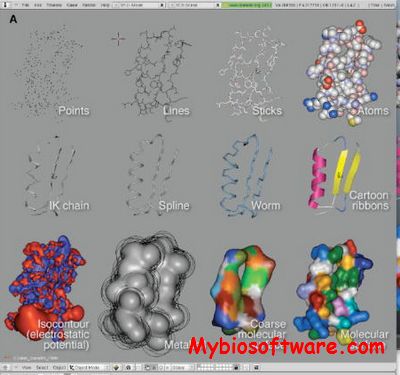
ePMV (embedded Python Molecular Viewer) runs molecular modeling software directly inside of professional 3D animation applications (hosts) to provide simultaneous access the capabilities of all of the systems. Uniting host and scientific algorithms into a single interface allows users from varied backgrounds to assemble professional quality visuals and to perform computational experiments with relative ease.
Mr T is a tomography software written in Python.Mr T uses the JAMES libraries to control the electron microscope and detector. Image processing is accomplished with EMAN.
Bioservices is a Python package that provides access to many Bioinformatices Web Services (e.g., UniProt) and a framework to easily implement Web Services wrappers (based on WSDL/SOAP or REST protocols).
PyNAST is a complete reimplementation of NAST. The Nearest Alignment Space Termination (NAST) tool is commonly used in sequence-based microbial ecology community analysis
PHENIX software suite is a highly automated system for macromolecular structure determination that can rapidly arrive at an initial partial model of a structure without significant human intervention, given moderate resolution and good quality data. This achievement has been made possible by the development of new algorithms for structure determination, maximum-likelihood molecular replacement (PHASER), heavy-atom search (HySS), template and pattern-based automated model-building (RESOLVE), automated macromolecular refinement (phenix.refine), and iterative model-building, density modification and refinement that can operate at moderate resolution (RESOLVE, AutoBuild). These algorithms are based on a highly integrated and comprehensive set of crystallographic libraries that have been built and made available to the community. The algorithms are tightly linked and made easily accessible to users through the PHENIX Wizards and the command line.
Citing PHENIX: PHENIX: a comprehensive Python-based system for macromolecular structure solution. P. D. Adams, P. V. Afonine, G. Bunkóczi, V. B. Chen, I. W. Davis, N. Echols, J. J. Headd, L.-W. Hung, G. J. Kapral, R. W. Grosse-Kunstleve, A. J. McCoy, N. W. Moriarty, R. Oeffner, R. J. Read, D. C. Richardson, J. S. Richardson, T. C. Terwilliger and P. H. Zwart. Acta Cryst.D66, 213-221 (2010).
Pysces is the Python Simulator of Cellular Systems. For a network of coupled reactions it does a stoichiometric matrix analysis, calculates the time course and steady state, and does a complete control analysis.
Pydna is an extensible, free and open source Python library for simulating basic molecular biology DNA unit operations such as restriction digestion, ligation, PCR, primer design, Gibson assembly and homologous recombination.
pmx (formerly pymacs) has started as a small bunch of classes to read structure files such as pdb or gro and trajectory data in gromacs xtc format. Over the years it has been extended towards a versatile (bio-) molecular structure manipulation package with some additional functionalities, e.g. gromacs file parsers and scripts for setup and analysis of free energy calculations.