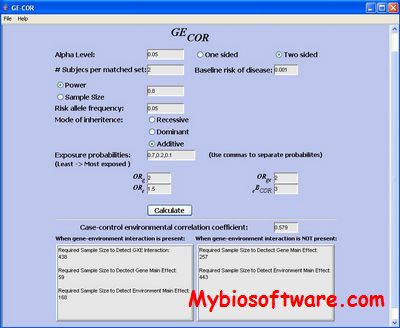
GECOR is a software for calculating sample sizes in matched case-control studies examining genetic and environmental factors,and/or gene-environment interaction. It allows for sample size calculations for the main effects of geneand/or environment, as well as gene-environment interaction.
MDSOutlier is a free, open-source whole-genome case-control association analysis program, designed for systematic removal of outliers to reduce heterogeneity.
SPREG is a computer program for performing regression analysis of secondary phenotype data in case-control association studies. Secondary phenotypes are quantitative or qualitative traits other than the case-control status. Because the case-control sample is not a random sample of the general population, standard statistical analysis of secondary phenotype data can yield very misleading results.
CNVineta is a flexible data mining tool for the analysis of copy number variations (CNVs) in large case-control SNP array data sets. The tool is available as an R statistical package. CNVineta offers a flexible and fast access to CNVs by a quick graphical overview in large case-control datasets. In addition, CNVineta provides rapid access to the log2 of raw data ratios (LRR) and B-allele frequencies (BAF) of specific or all samples, thereby allowing for a fast verification of the underlying raw data. CNVineta is also equipped with analysis methods for genome-wide screening for associated rare as well as common CNVs. Hence, CNVineta is a unique data mining tool to rapidly explore CNVs in large case-control data sets.
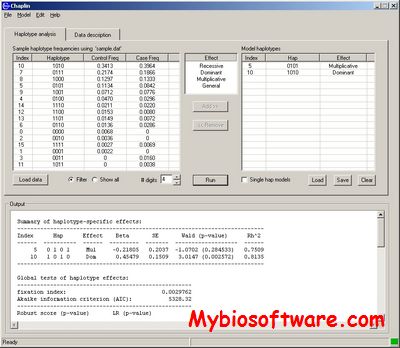
Chaplin (Case-control haplotype inference package.) is a software program for identifying specific haplotypes or haplotype features that are associated with disease using genotype data from a case-control study.
LRASSOC suite deals with the situation where we have a case-control sample of affected and unaffected individuals with their marker genotypes for 2 biallelic marker loci. These 2 marker loci may be in linkage disequilibrium with 1 or 2 biallelic disease susceptibility loci and therefore affect disease risk through association or may themselves be disease susceptibility loci. We are interested in modelling the effects of the genotype on the probability of disease risk in order to draw conclusions regarding the nature of the joint effect of the loci. Among the issues we may wish to investigate are whether either of the 2 loci actually has an effect on disease risk, the strength and statistical significance of any effect, the nature of such an effect e.g is the effect additive on some scale or do the alleles at the same loci interact in a dominance effect. We also want to compare single and joint locus models to investigate how the strength and significance of the effect of each locus is affected by the presence or absence of the other in a model and, a related point, whether the additive and dominance effects of two loci are independent or whether they interact (often called epistasis in this context).
LTSOFT is a software suite designed to more powerfully leverage clinical-covariates such as age, bmi, smoking status, and gender as well as genetic-covariates such as known associated variants when conducting case-control association studies. Including these covariates in standard regression models is not only suboptimal, but can in many instances reduce power.
Bioinformatics. 2012 Jul 1;28(13):1729-37. doi: 10.1093/bioinformatics/bts259. Epub 2012 May 3. Analysis of case-control association studies with known risk variants.
Zaitlen N, Pasaniuc B, Patterson N, Pollack S, Voight B, Groop L, Altshuler D, Henderson BE, Kolonel LN, Le Marchand L, Waters K, Haiman CA, Stranger BE, Dermitzakis ET, Kraft P, Price AL.